[USPS] How to Send a Letter or Postcard: International
Sending a letter or postcard internationally through USPS means mailing written correspondence from the United States to an address in another country. This can include personal letters, greeting cards, invitations, and simple postcards. While the overall process is straightforward, international mail is subject to service availability, mailing standards, customs rules in some cases, and destination-country restrictions.
Delivery times, postage prices, tracking availability, and mailing requirements can vary depending on the country you are sending to and the USPS international service you choose. Before you mail anything, it is important to review the current USPS standards and also check any destination-country restrictions that could affect acceptance or delivery.
Who This Guide Is For
This guide is intended for people who want a simple overview of how to send lightweight correspondence abroad through USPS.
- People sending personal letters, greeting cards, invitations, or postcards to another country
- Individuals and small senders mailing lightweight correspondence internationally
- First-time USPS users who need a step-by-step explanation of the process
What Counts as a Letter or Postcard
Letter
A letter is generally paper correspondence placed inside an envelope. It is commonly used for written messages, printed documents, greeting cards, or similar paper contents.
Postcard
A postcard is usually a single card mailed without an envelope. It is often used for short messages, travel greetings, or simple announcements.
Why the Difference Matters
Size, shape, thickness, rigidity, and contents can affect whether your item qualifies at the letter or postcard rate. If you add bulky enclosures, make the item uneven, or use a nonstandard format, it may no longer be treated as a standard letter or postcard for mailing purposes.
Check Whether the Contents Are Eligible
Before mailing, confirm that your item contains only allowable contents for the service and format you plan to use. A paper letter is not always treated the same way as an envelope containing goods or non-paper items.
Review restrictions carefully if your mail includes anything beyond ordinary correspondence, especially:
- Merchandise or goods
- Cash or negotiable items
- Sensitive materials or prohibited items
- Enclosures that could change the classification of the mailpiece
Destination countries may also have their own import prohibitions and mailing restrictions. Even if an item is accepted for mailing in the United States, it may still face delay, return, or refusal if it does not meet the destination country's rules.
Choose the Right USPS International Mail Service
USPS offers multiple international mail services, but not every service is available for every destination or every type of item. When choosing a service for an international letter or postcard, compare the following:
- Destination country
- Estimated delivery speed
- Tracking availability
- Cost
It is also important to confirm that the service you select supports the item type you are mailing. Some services may offer limited tracking or no tracking at all for certain destinations, especially for standard correspondence.
If tracking visibility matters, check service details before mailing rather than assuming it will be included.
Understand Size, Weight, and Packaging Rules
International letters and postcards must meet USPS format standards. If your item falls outside the allowed dimensions or physical characteristics, it may require different postage or a different mailing service.
Check these points before you mail:
- Minimum and maximum dimensions
- Thickness requirements
- Weight limits
- Condition of the envelope or card
Try to avoid:
- Bulky enclosures
- Uneven thickness
- Rigid or oddly shaped packaging unless specifically permitted
- Damaged, torn, or poorly sealed envelopes
A mailpiece that looks simple may still be reclassified if it cannot be processed as a standard letter or postcard.
Address the Mail Correctly
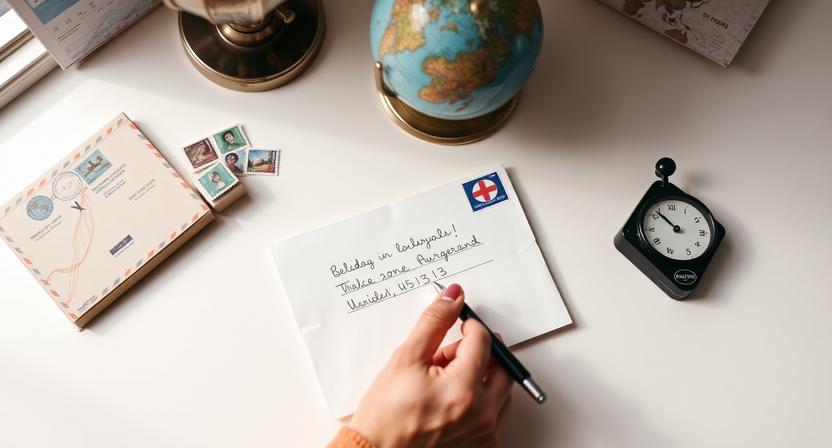
Write the recipient address clearly and completely. A complete international address usually includes:
- Recipient name
- Street address or delivery line
- City or locality
- Postal code
- Destination country written in capital letters on the last line
Add your return address in the usual return address location. Use clear handwriting or a printed label that is easy to read. If possible, follow the destination country's preferred address format to reduce the chance of delays.
Basic Addressing Reminders
- Do not omit the postal code if one is required
- Spell the country name clearly in English and use capital letters
- Keep the address block clean and unobstructed
- Do not place stamps, labels, or markings over the address
Prepare Customs Information if Required
Whether a customs form is required depends on the contents and the service used. Letters containing only correspondence may be treated differently from mailpieces that contain goods or other non-document items.
If a customs declaration is required, describe the contents accurately and completely. Incorrect or incomplete customs information can lead to delays, return, or other delivery issues.
Do not assume that every envelope can be mailed without customs review. If you include anything beyond ordinary written correspondence, check the current USPS requirements before mailing.
Calculate Postage
International postage depends on several factors. Before applying stamps or buying postage, confirm the current USPS rate for your destination and mail format.
Postage may vary based on:
- Mail class
- Weight
- Shape or nonmachinable characteristics
- Extra services, if available
You can usually purchase postage at a Post Office, self-service kiosk where available, or an approved online postage option if the selected service supports it.
Add Stamps or Print a Shipping Label
Use the correct amount of international postage for the destination and service selected. If you are using stamps, place them neatly in the designated postage area. If you are using printed postage, make sure the label is readable and attached securely.
- Do not cover the recipient address
- Do not cover barcodes or service markings
- Do not place tape over important mailing information unless allowed
If you are unsure whether the postage is correct, it is safer to have the item checked at a USPS retail location before mailing.
Submit the Mail
Some international letters or postcards with proper postage may be deposited in an approved USPS collection location. However, you should bring the item to a USPS retail counter when:
- You need postage verification
- A customs form is required
- You want confirmation that the item meets international mailing standards
If USPS provides a receipt or proof of mailing, keep it in case you need to reference the mailing details later.
Tracking and Delivery Expectations
Tracking is not available for every international letter or postcard service. Availability depends on the service selected and the destination country. In some cases, only limited tracking or no tracking may be offered for standard correspondence.
Delivery times for international mail can vary for many reasons, including:
- Distance
- Customs processing
- Transportation connections
- Handling by the destination country's postal operator
- Seasonal volume or service disruptions
If a tracking number is provided, it can be entered on the USPS tracking page. Keep in mind that update frequency and final delivery scans may vary by country and service.
Common Reasons for Delay or Return
International letters and postcards can be delayed or returned for several common reasons:
- Incorrect or incomplete address
- Missing or insufficient postage
- The item does not meet letter or postcard format requirements
- Customs issues or missing declarations
- Destination-country restrictions
- Illegible writing
- Damaged packaging
Even a small issue, such as an unreadable postal code or an enclosure that changes the mail classification, can affect how the item is processed.
Tips for a Smoother International Mailing Experience
- Verify the destination address format before mailing
- Weigh and measure the item carefully
- Confirm whether tracking is included, optional, or unavailable
- Avoid adding objects that may change the item from correspondence to goods
- Mail early during holiday periods or other peak mailing seasons
- Review destination-country restrictions before going to the Post Office
FAQs
Can I send a postcard internationally with regular stamps?
You need enough postage to cover the applicable USPS international postcard rate or other required rate based on the item's characteristics. A domestic stamp amount may not be sufficient for international mailing.
Do international letters require a customs form?
Not always. Letters containing only correspondence may be treated differently from items containing goods or non-document contents. If you include anything beyond ordinary written correspondence, review the current USPS rules to see whether a customs form is required.
Can I track an international letter sent through USPS?
Sometimes. Tracking depends on the USPS service used and the destination country. Some international letter services offer limited or no tracking.
How long does an international postcard usually take?
There is no single transit time that applies to every destination. Delivery can vary based on the country, service selected, customs procedures where applicable, and local postal handling after arrival.
What happens if I wrote the address in the wrong format?
The mail may still be delivered if the address remains clear and complete enough for postal processing, but an incorrect format can increase the chance of delay, misrouting, or return. If you notice an error before mailing, it is best to correct it first.
Quick Reference Table
| Step | What to Check | Why It Matters |
|---|---|---|
| Contents | Correspondence only or includes goods | May affect customs requirements and mail classification |
| Format | Size, weight, thickness, flexibility | Determines whether it qualifies as a letter or postcard |
| Service | Destination, speed, tracking, cost | Not all services are available for all countries |
| Address | Complete recipient details and country name | Helps avoid delay or return |
| Postage | Current international rate | Insufficient postage can prevent proper processing |
| Customs | Required or not for the contents | Missing details can cause delay or return |
Conclusion
To send a letter or postcard internationally through USPS, start by confirming that the contents are eligible, choose a service that fits the destination and your needs, address the item clearly, and apply the correct postage. Also check whether any customs information is required and whether the destination country has restrictions that could affect delivery.
Because international mailing standards and service details can change, it is wise to verify the current USPS requirements before sending. If delivery visibility is important, consider choosing a service that offers tracking for the destination whenever that option is available.